Wednesday, March 7, 2012
Features of Extra Fine Silver Powder
The silicon metal is Silver gray or dark grey powder, Heat-resistance and good performance.
Application
Extra Fine Silver Powder possesses quite widely. For example, to produce organic-Si(Si-oil, Si-rubber) etc in chemical industry. And also regarding the no-ferroalloy’s additive, deoxidize, silicon-steel etc alloys adding materials. It’s applied to mechanical, chemical, alloys, electronic, medicine industry etc.
Extra Fine Silver Powder's widely used in the fields of electric conductive and magnetic conductive materials, high performance electronic pulp, high efficient catalyst and antibiotic reagent.
More about: Extra Fine Silver Powder sale
Read more: Chemical Compound
Specifications of O-Acetylricinoleic Acid Methyl Ester
Description of O-Acetylricinoleic Acid Methyl Ester
O-Acetylricinoleic Acid Methyl Ester is also called methyl (Z)-12-acetyloxyoctadec-9-enoate. CAS is 140-03-4. Molecular Formula is C21H38O4. Molecular Weight is 354.52g/mol.
The melting point of O-Acetylricinoleic Acid Methyl Ester is -26°C and baking point is 185°C at 2mmHg. Its abstention is not beneath than 80.0%(GC). The blueprint is 25ML or 500ML.
More about: O-Acetylricinoleic Acid Methyl Ester Sale
Read more: chemical materials
O-Acetylricinoleic Acid Methyl Ester is also called methyl (Z)-12-acetyloxyoctadec-9-enoate. CAS is 140-03-4. Molecular Formula is C21H38O4. Molecular Weight is 354.52g/mol.
The melting point of O-Acetylricinoleic Acid Methyl Ester is -26°C and baking point is 185°C at 2mmHg. Its abstention is not beneath than 80.0%(GC). The blueprint is 25ML or 500ML.
More about: O-Acetylricinoleic Acid Methyl Ester Sale
Read more: chemical materials
Monday, March 5, 2012
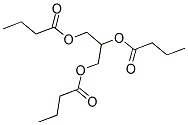
Definitions of Tributyrin
Tributyrin, also known as Butyrin, is a triglyceride naturally present in butter. It is an ester composed of butyric acid and glycerol. Among other things, it is used as an ingredient in making margarine. It is commonly occurring in butter and can be described as a liquid fat with an acrid taste.
Tributyrin is also used in microbiological laboratories to identify the bacterium Moraxella catarrhalis.
Tributyrin is a stable and rapidly absorbed prodrug of butyric acid which enhances antiproliferative effects of dihydroxycholecalciferol in human colon cancer cells.
Tributyrin has broad anti-cancer actions and synergizes many therapies. This approved food additive also normalizes mitochondrial membrane potential.
Tributyrin, a triglyceride analogue of butyric acid (butyryl triglyceride), is similar in structure to 95% of the fatty acids found in foods, can be p.o.(orally) administered, is well tolerated even by young children, and is an approved food additive.
More about: Tributyrin sale
Read more: chemical materials
Tributyrin is also used in microbiological laboratories to identify the bacterium Moraxella catarrhalis.
Tributyrin is a stable and rapidly absorbed prodrug of butyric acid which enhances antiproliferative effects of dihydroxycholecalciferol in human colon cancer cells.
Tributyrin has broad anti-cancer actions and synergizes many therapies. This approved food additive also normalizes mitochondrial membrane potential.
Tributyrin, a triglyceride analogue of butyric acid (butyryl triglyceride), is similar in structure to 95% of the fatty acids found in foods, can be p.o.(orally) administered, is well tolerated even by young children, and is an approved food additive.
More about: Tributyrin sale
Read more: chemical materials
What is Terephthaloyl Chloride?
Terephthaloyl Chloride (TCL, 1,4-benzenedicarbonyl chloride) is the acid chloride of terephthalic acid and is one of two monomers used to make Kevlar, the other being p-phenylenediamine. Its CAS reference number is 100-20-9 and its chemical formula is C8H4Cl2O2.
TCL is used as a key component in performance polymers and aramid fibers, where it imparts flame resistance, chemical resistance, temperature stability, light weight, and very high strength. TCL is also an effective water scavenger, used to stabilize isocyanates and urethane prepolymers.
Terephthaloyl Chloride is a white crystalline solid at room temperature, soluble in common organic solvents. Its melting point is 81.5-83 °C, its boiling point is 265 °C. It is corrosive.
TCL is used for making various copolymers and aramid polymers such as Twaron and kevlar
More about: Terephthaloyl Chloride sale
Read more: chemical materials
TCL is used as a key component in performance polymers and aramid fibers, where it imparts flame resistance, chemical resistance, temperature stability, light weight, and very high strength. TCL is also an effective water scavenger, used to stabilize isocyanates and urethane prepolymers.
Terephthaloyl Chloride is a white crystalline solid at room temperature, soluble in common organic solvents. Its melting point is 81.5-83 °C, its boiling point is 265 °C. It is corrosive.
TCL is used for making various copolymers and aramid polymers such as Twaron and kevlar
More about: Terephthaloyl Chloride sale
Read more: chemical materials
Sunday, March 4, 2012
What is 2-Nitrobiphenyl?
2-Nitrobiphenyl
CAS:86-00-0
Molecular Formula:C12H9NO2
Molecular Weight: 199.21g/mol
vapor density 5.9 (vs air)
vapor pressure 2 mmHg ( 140 °C)
assay 97%
autoignition temp. 356 °F
bp 165-170 °C/13 mmHg(lit.)
mp 36-38 °C(lit.)
2-Nitrobiphenyl occurs as gold to tan crystals or brown solid with its melting point 36-38 °C(lit.) and boiling point 320 °C. 2-Nitrobiphenyl is insoluble in water. Its purity is not less than 98.0%(GC). 2-Nitrobiphenyl's the grade of EP.The specification is 25G or 500G.
More about: 2-Nitrobiphenyl sale
Read more: chemical materials
CAS:86-00-0
Molecular Formula:C12H9NO2
Molecular Weight: 199.21g/mol
vapor density 5.9 (vs air)
vapor pressure 2 mmHg ( 140 °C)
assay 97%
autoignition temp. 356 °F
bp 165-170 °C/13 mmHg(lit.)
mp 36-38 °C(lit.)
2-Nitrobiphenyl occurs as gold to tan crystals or brown solid with its melting point 36-38 °C(lit.) and boiling point 320 °C. 2-Nitrobiphenyl is insoluble in water. Its purity is not less than 98.0%(GC). 2-Nitrobiphenyl's the grade of EP.The specification is 25G or 500G.
More about: 2-Nitrobiphenyl sale
Read more: chemical materials
Descriptions of TCPP (Tetrakis(4-carboxyphenyl)porphyrin Ultra-high sensitive spectrophotometric reagent for Cu, Cd For the simultaneous determination of metals by HPLC)
TCPP (Tetrakis(4-carboxyphenyl)porphyrin Ultra-high sensitive spectrophotometric reagent for Cu, Cd For the simultaneous determination of metals by HPLC)
CAS:14609-54-2
Molecular Formula:C48H30N4O8
Molecular Weight: 790.77g/mol
Description of TCPP (Tetrakis(4-carboxyphenyl)porphyrin Ultra-high sensitive spectrophotometric reagent for Cu, Cd For the simultaneous determination of metals by HPLC)
TCPP (Tetrakis(4-carboxyphenyl)porphyrin Ultra-high sensitive spectrophotometric reagent for Cu, Cd For the simultaneous determination of metals by HPLC)'s purity is not less than 97.0%(LC)(T).Its grade is Ace.Its specification is 100mg or 1g.
Synonyms
Mtcpp;Aids006254;Aids-006254;NICKEL IONOPHORE II;RARECHEM AS SA 0048;tetracarboxyphenylporphine;TETRACARBOXYPHENYLPORPHYRIN;Tetrakis(carboxphenyl)porphyrin;TETRAKIS(4-CARBOXYPHENYL)PORPHINE;Tetrakis(4-carboxyphenyl)porphyrin
More about: TCPP (Tetrakis(4-carboxyphenyl)porphyrin Ultra-high sensitive spectrophotometric reagent for Cu, Cd For the simultaneous determination of metals by HPLC) sale
Read more: chemical materials
CAS:14609-54-2
Molecular Formula:C48H30N4O8
Molecular Weight: 790.77g/mol
Description of TCPP (Tetrakis(4-carboxyphenyl)porphyrin Ultra-high sensitive spectrophotometric reagent for Cu, Cd For the simultaneous determination of metals by HPLC)
TCPP (Tetrakis(4-carboxyphenyl)porphyrin Ultra-high sensitive spectrophotometric reagent for Cu, Cd For the simultaneous determination of metals by HPLC)'s purity is not less than 97.0%(LC)(T).Its grade is Ace.Its specification is 100mg or 1g.
Synonyms
Mtcpp;Aids006254;Aids-006254;NICKEL IONOPHORE II;RARECHEM AS SA 0048;tetracarboxyphenylporphine;TETRACARBOXYPHENYLPORPHYRIN;Tetrakis(carboxphenyl)porphyrin;TETRAKIS(4-CARBOXYPHENYL)PORPHINE;Tetrakis(4-carboxyphenyl)porphyrin
More about: TCPP (Tetrakis(4-carboxyphenyl)porphyrin Ultra-high sensitive spectrophotometric reagent for Cu, Cd For the simultaneous determination of metals by HPLC) sale
Read more: chemical materials
Thursday, March 1, 2012
Functions of Laccaic Acid from Lacca
Description
Laccaic Acid from Lacca is a red colored natural dye produced by the insect Laccifer lacca or Coccus lacca. It is obtained in large amounts as a by-product of the shellac industry and has been considered for general use as a food coloring agent. Laccaic acid is found to have no mutagenic activity as assessed by two short-term assays: the Salmonella/microsome mutagenicity test, and the ØX fidelity assay. However, laccaic acid did inhibit metabolic cooperation in Chinese hamster V79 cells. These results suggest that laccaic acid should be tested in animals with particular emphasis on in vivo models for tumor promotion.
Function of Laccaic Acid from Lacca
With the function of natural food red color pigment, it is widely used in baked food, beverages of fruit vegetable juice (pulp), fruit flavoured beverages,soda pop, compound seasonings, jam, ice cream, ham, sausage,chocolate and candy products, it has good coloring effect
Application:
Applied in food field, it is mainly used as natural food additives for pigment
Applied in cosmetic field and pharmaceuticals , it is mainly used as red pigment
As senior dye, widely used in textile manufacturing industry, such as toys, senior textile, wool products and more
Storage: store in cool and dry places, keep away from light
More about: Laccaic Acid from Lacca sale
Read more: chemical materials
Laccaic Acid from Lacca is a red colored natural dye produced by the insect Laccifer lacca or Coccus lacca. It is obtained in large amounts as a by-product of the shellac industry and has been considered for general use as a food coloring agent. Laccaic acid is found to have no mutagenic activity as assessed by two short-term assays: the Salmonella/microsome mutagenicity test, and the ØX fidelity assay. However, laccaic acid did inhibit metabolic cooperation in Chinese hamster V79 cells. These results suggest that laccaic acid should be tested in animals with particular emphasis on in vivo models for tumor promotion.
Function of Laccaic Acid from Lacca
With the function of natural food red color pigment, it is widely used in baked food, beverages of fruit vegetable juice (pulp), fruit flavoured beverages,soda pop, compound seasonings, jam, ice cream, ham, sausage,chocolate and candy products, it has good coloring effect
Application:
Applied in food field, it is mainly used as natural food additives for pigment
Applied in cosmetic field and pharmaceuticals , it is mainly used as red pigment
As senior dye, widely used in textile manufacturing industry, such as toys, senior textile, wool products and more
Storage: store in cool and dry places, keep away from light
More about: Laccaic Acid from Lacca sale
Read more: chemical materials
Subscribe to:
Posts (Atom)